
Note
Go to the end to download the full example code.
Laser Speckle Patterns#
Simulates laser speckle, the granular intensity pattern formed when coherent light scatters from a rough surface or propagates through a random medium. Speckle is ubiquitous in laser applications and has both practical uses (speckle imaging, metrology) and challenges (image degradation).
import matplotlib.pyplot as plt
import torch

import torchoptics
from torchoptics import Field, visualize_tensor
from torchoptics.profiles import circle, gaussian
Simulation Parameters#
Speckle arises from the interference of many wavefronts with random phases. The characteristic speckle size depends on the wavelength, propagation distance, and the size of the illuminated area.
shape = 512  # Grid size
spacing = 5e-6  # Grid spacing (m)
wavelength = 632.8e-9  # HeNe laser (m)

beam_radius = 1e-3  # Illumination beam radius (m)

# Configure torchoptics defaults
torchoptics.set_default_spacing(spacing)
torchoptics.set_default_wavelength(wavelength)

device = "cuda" if torch.cuda.is_available() else "cpu"
Random Phase Screen#
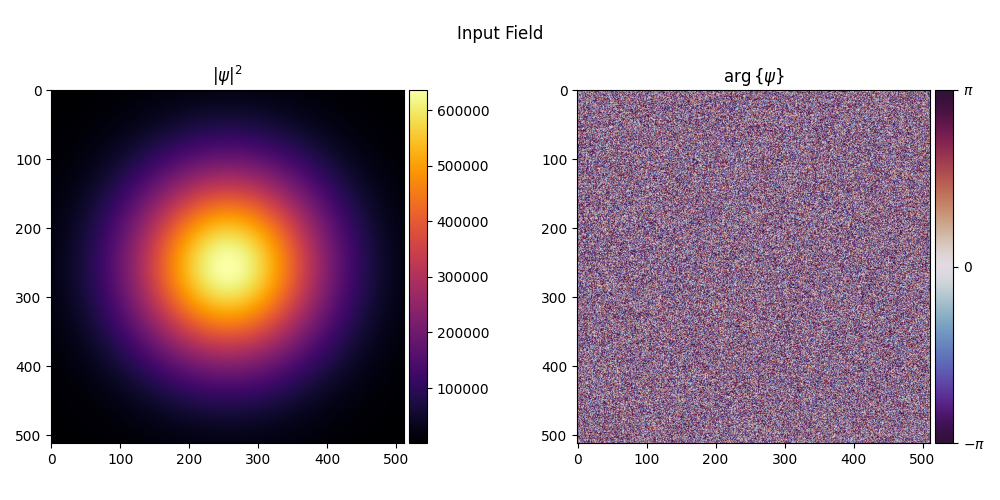
A rough surface introduces random phase variations. The phase is often modeled as uniformly distributed over \([0, 2\pi]\), representing surface height variations much larger than the wavelength.
# Create random phase screen (fully developed speckle)
random_phase = 2 * torch.pi * torch.rand(shape, shape)

# Illumination: Gaussian beam
amplitude = gaussian(shape, waist_radius=beam_radius)

# Create Field object
input_field = Field(amplitude * torch.exp(1j * random_phase)).to(device)

input_field.visualize(title="Input Field")
Far-Field Speckle#
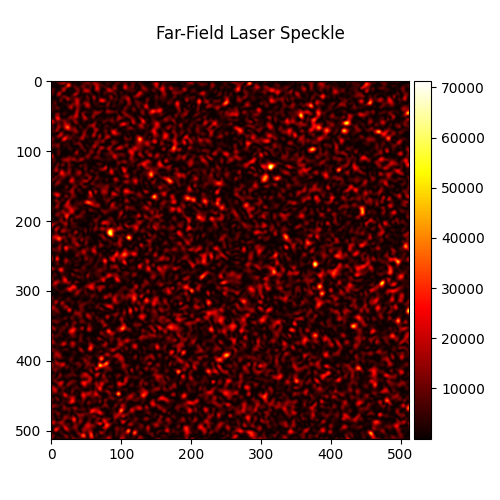
After propagation, the random phases interfere to create the characteristic granular speckle pattern. The speckle size in the far field is approximately:
where \(D\) is the diameter of the illuminated area.
# Propagate to far field
propagation_distance = 100e-3  # 100 mm
output_field = input_field.propagate_to_z(propagation_distance)
speckle_pattern = output_field.intensity().cpu()

visualize_tensor(speckle_pattern, title="Far-Field Laser Speckle", cmap="hot")
Speckle Statistics#
For fully developed speckle (uniform random phase), the intensity follows a negative exponential distribution:
The standard deviation equals the mean, giving a speckle contrast of 1.
# Flatten the speckle pattern for statistics
speckle_flat = speckle_pattern.flatten()
mean_intensity = speckle_flat.mean()
std_intensity = speckle_flat.std()
contrast = std_intensity / mean_intensity

print(f"Mean intensity: {mean_intensity:.4f}")
print(f"Standard deviation: {std_intensity:.4f}")
print(f"Speckle contrast (C = σ/μ): {contrast:.3f}")
print("Theoretical contrast for fully developed speckle: 1.0")

# Histogram
fig, ax = plt.subplots(figsize=(8, 5))

# Normalize intensities
normalized = speckle_flat / mean_intensity
ax.hist(normalized, bins=100, density=True, alpha=0.7, color="steelblue", label="Simulation")

# Theoretical negative exponential
I_theory = torch.linspace(0, 8, 200)
p_theory = torch.exp(-I_theory)
ax.plot(I_theory, p_theory, "r-", linewidth=2, label=r"Theory: $p(I) = e^{-I/\langle I \rangle}$")

ax.set_xlabel(r"Normalized Intensity $I/\langle I \rangle$")
ax.set_ylabel("Probability Density")
ax.set_title("Speckle Intensity Distribution")
ax.legend()
ax.set_xlim(0, 8)
ax.grid(True, alpha=0.3)
plt.tight_layout()
plt.show()
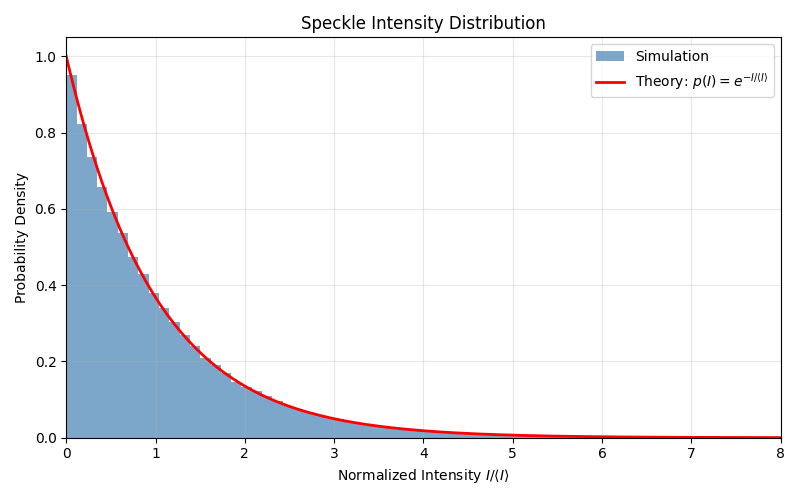
Mean intensity: 6175.5714
Standard deviation: 6109.2800
Speckle contrast (C = σ/μ): 0.989
Theoretical contrast for fully developed speckle: 1.0
Speckle Size vs. Aperture#
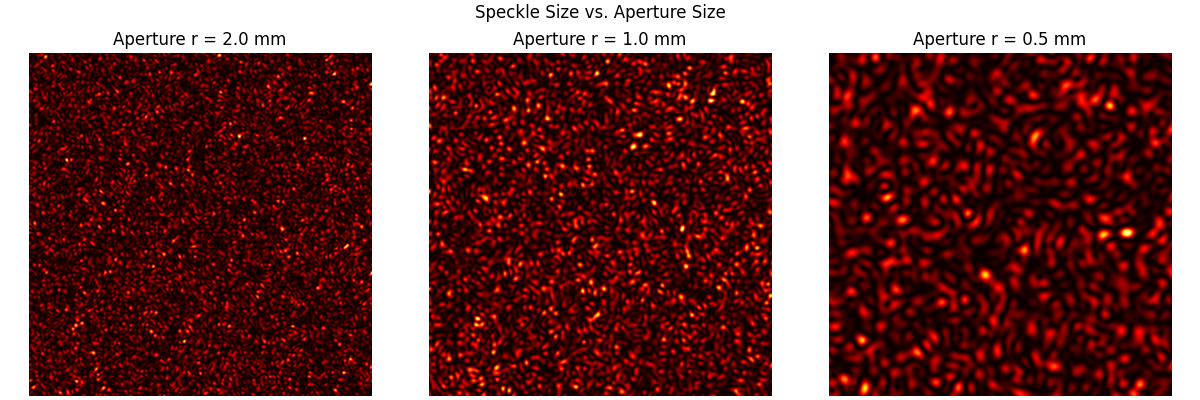
The average speckle size increases as the illuminated area decreases. We demonstrate this with different aperture sizes.
aperture_radii = [2e-3, 1e-3, 0.5e-3]
fig, axes = plt.subplots(1, 3, figsize=(12, 4), constrained_layout=True)

for ax, radius in zip(axes, aperture_radii):
    # Circular aperture
    aperture = circle(shape, radius)
    scattered = aperture * torch.exp(1j * random_phase)
    field = Field(scattered).to(device)
    output = field.propagate_to_z(propagation_distance)

    ax.imshow(output.intensity().cpu(), cmap="hot")
    ax.set_title(f"Aperture r = {radius * 1e3:.1f} mm")
    ax.axis("off")

plt.suptitle("Speckle Size vs. Aperture Size", fontsize=12)
plt.show()
Total running time of the script: (0 minutes 1.083 seconds)